Have you been hearing about (or seen first-hand) Google's “AI Overviews” and "AI Mode" showing up in search results and wondered what it means for the visibility of small business (SMBs)?
With the introduction of Artificial Intelligence (AI) directly into the Google search process, the way people find local services, professional help, or product recommendations is changing quickly. AI now summarizes answers right in the search results, pulling from a mix of websites it deems trustworthy, relevant, and helpful.
But how do you rank in AI Overviews and AI tools and make sure your business is part of that conversation? In this post, we break down a bit of what’s actually happening behind the scenes—and what practical steps small and mid-sized service businesses can take to rank in AI Overviews, get cited in AI tools, and stay visible in AI-powered search.
What's the Ranking in AI Shift About?
Google has said you don't need to do anything special to appear in AI Overviews....
Google says you don’t need to do anything special to appear in AI Overviews—and technically, that may be true. But when your small business is competing for visibility in an AI-driven search environment, it’s not just about being present—it’s about being chosen. Traditional SEO still matters, but some tactics may now deserve more of your focus than others.
With limited time and budget, it makes sense to prioritize the strategies that help both search engines and AI understand, trust, and highlight your business.
"LLM Seeding"—The Mindset Behind These Strategies
One strategy emerging from the forefront of this shift: LLM Seeding. According to Backlinko, LLM Seeding is all about publishing your content in formats and places where AI systems like ChatGPT, Claude, or Perplexity naturally "scrape, summarize, and cite".
How LLM Seeding works in your favor:
Create AI-friendly content—think listicles, comparison charts, FAQs, clear definitions—that’s easy for models to digest.
Seed that content across platforms AI often learns from—even if they don’t link back to you. You’re building citations, not backlinks..
As models absorb and reference your content, your brand becomes part of AI-generated answers—even if users never click through to you.
This isn’t about ranking in the traditional sense; it’s about becoming a trusted voice in AI’s knowledge base.
You’ve probably already seen AI Overviews in Google—those summaries at the top of search results that instantly answer your question without needing to click a link.
Google AI Mode
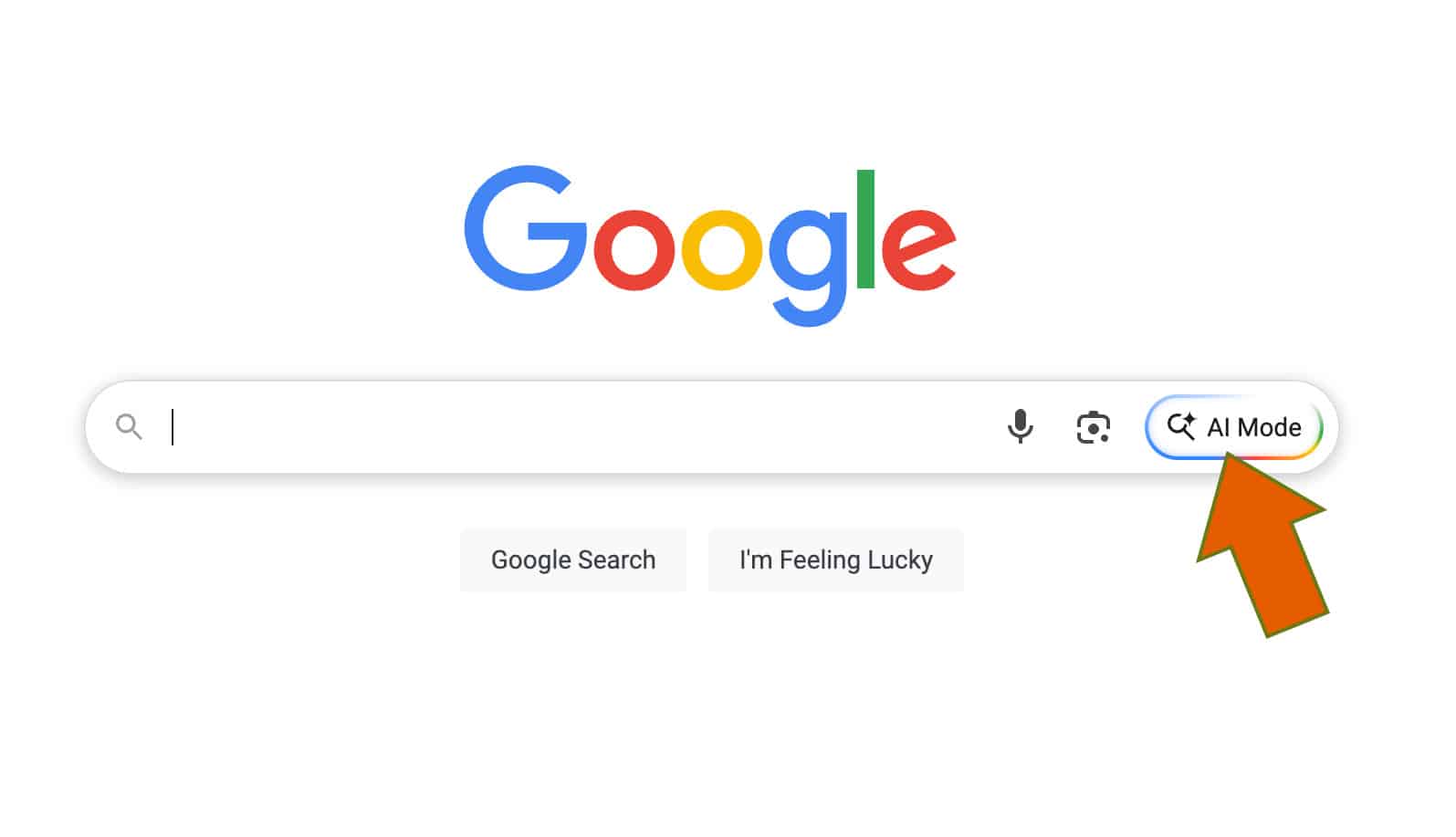
AI Mode takes it further. AI Mode is Google’s new conversational search experience where users interact with an AI assistant instead of browsing a list of links. You can access it via the "AI Mode" button on the Google home page.
These changes are reshaping search results—and with fewer clicks going to actual websites, they’re already disrupting traditional SEO strategies and organic traffic patterns. If your content isn’t being cited by AI, you may get left out entirely.
If you want your business to be one of the sources AI turns to, now’s the time to start optimizing for how AI finds and uses information.
How Does Google AI Decide What to Include in Overviews or AI Mode...Do We Even Know?
The "SEO expert" community is beginning to understand some of the signals, but Google isn’t telling us everything, of course. Still, based on on patents, public statements, and behavior observed in AI Overviews and AI Mode, here’s what is known (or strongly suspected):
What We Know or Can Infer about AI Search Results:
1. "Passage-Level Retrieval" is Key for Appearing in AI Results
What does 'passage-level retrieval' mean?
It means Google isn’t just ranking whole pages—it’s pulling specific paragraphs or snippets that best answer the query or subquery (passage-level). This means your content needs to have clearly written, self-contained passages that directly answer questions.
Don't refer to other parts of the article...make sure that the paragraph has all the info needed. Imagine that if you screenshot part of the article and send it to someone, it will make sense.
Skim-friendly content is good for everyone.
2. Google's AI Mode "Query Fan-Out" = More Entry Points
Google AI Mode expands user queries into many potential subquestions, known as "query fan-out" (QFO). AI then searches for the best content to match those queries in addition to the original query. Why?AI Mode uses this process to assemble a 'custom corpus' of information it can use to understand both...
The context of the original query
Answers to likely follow up questions
So...the thinking is, the more subqueries your content can address, the better. The more of these you answer in your content, the more opportunities you'll have to intersect with the QFO subqueries and be pulled in to an AI answer.
Example of a Query Fan-Out
This graphic shows a Query Fan-Out (QFO) example for someone searching for a landscaping company to install poolside lighting and landscaping. It breaks the main query into different facets and sub-queries, then matches each to examples of specific types of content that could intersect or target each of the subqueries—like service pages, blog posts, city landing pages, testimonials, and portfolio examples. It highlights how one search in an AI tool can branch into many related queries, and how targeted content for each can boost visibility in AI Overviews, AI Mode, and traditional search.
Example of a Query Fan-Out for a search related to a landscaping company illustrating content that matches QFO subqueries.
3. Semantic Richness & Relevance Win in AI Results
This means it’s not just about keywords—it’s about meaning. AI prefers content that deeply aligns with the intent behind the query. So semantically rich, topically focused writing increases your chances of inclusion in AI search results. Producing content in this way has been a best practice in SEO for a while, it's just perhaps more important now.
4. Your Content is Used, Not Ranked Like We Are Accustomed to in Regular Search Results
AI Mode doesn’t serve links in ranked order—it pulls pieces from across the web to compose an answer. So your content might be included in an AI Overview or AI Mode without you ever showing up in traditional search results.
6. Personal Context & User History Influence Results
AI results are often personalized based on user search history, location, or even Gmail content (for signed-in users). So inclusion of your business in an AI Tool or AI Mode conversation can depend on that particular user's (very) personal context—not just content. This means that content on your site that targets very specific types of customers, or verticals/industries can pay off in earning you a mention.
For example...if the owner of a construction company is looking for website design and SEO, because we have a page that targets web design & SEO for construction companies, we might be seen as a better choice for AI to mention in that particular user's AI conversation.
11 To-Do's for Small Businesses to Rank in AI Overviews, AI Mode & LLMs
Our clients instinctively know that "there are a lot of changes going on at Google" because of AI. It's our role to help synthesize the new information around optimizing for AI search and translate it into actionable items. That's what we have attempted to do here in this next section.
Here are 11 strategies for small businesses to work on to enhance your chances ranking in AI search results and being cited in AI search results (with actionable steps):
1. Cultivate & Manage a Strong Online Reputation
(Time to Impact: Medium | Difficulty: Easy)
In my opinion, managing your reputation is even more important now -- because of AI's ability to pull in dozens of sources, synthesize that information and produce an overview for the searcher. Previously, you may not have worried too much about that low rating from a disgruntled employee on Glassdoor because the chances that someone searching would actually see that review were pretty low.
Now, in AI Mode and AI Overviews, AI might bring it up and point it out to the searcher (awkward!) -- Especially in the context of a personalized search where AI knows the searcher "cares about workplace fairness".
What to do to improve and manage online reputation:
Encourage clients to leave reviews on Google, Clutch, etc. Depending on your industry, it can be hard to get clients to review you, but put this on your to-do list every week or month to ask a happy client for a review -- never buy fake reviews. Make it easier for clients by sending them links directly to where they can review you -- with the exception of Yelp. Yelp doesn't want you to ask people to review you, so if a client arrives to your Yelp profile via direct link, generally Yelp will ignore the review.
Respond thoughtfully to reviews on platforms where you are able to do that. Definitely respond to all reviews on Google whether good or bad. (See how to respond to negative reviews »)
Display reviews and testimonials on your site. Include testimonials in the case studies published on your website.
If you have a problem with bad reviews, work to figure out why they are happening and fix the business issues that are triggering bad reviews.
Why it matters: AI favors businesses trusted by real people and it KNOWS EVERYTHING that has been published online about your business reputation -- good and bad. You have to work on making sure the good really outweighs the bad.
LLM Seeding connection: Reviews, testimonials, and public responses are prime AI training data. The more trustworthy, consistent, and detailed they are, the more likely AI will use them to describe your business.
2. Increase Brand Recognition & Visibility
(Time to Impact: Medium | Difficulty: Easy)
When people hear “brand recognition,” they often think of big companies with big ad budgets. But small and medium-sized businesses can boost their brand awareness too—often in simple, local, or niche-specific ways that make a big difference, such as:
Getting featured in reputable lists (e.g., “Best WordPress web design agency in Atlanta”)
Sponsoring local events, charities, or community initiatives -- Find local sponsorship opportunities that help tie your business to your community
Earning mentions on highly cited sites: local news, professional associations, directories
Why it matters: When your business gets mentioned across reputable and relevant websites—especially in your niche or region—it sends strong signals that your brand is trustworthy and relevant. AI tools notice those signals and are more likely to include your business in responses.
LLM Seeding connection⇒ Getting mentioned on reputable, well-crawled sites “seeds” your brand into AI’s knowledge base—especially when your business name appears alongside niche-relevant terms.
How to Increase the "Brand Awareness" of a Small Business:
Get Listed: Search for “Best [your industry] in [your city]” ....look for search results that are "Lists" and submit your business to be included where possible. Make sure you are listed on the websites of any relevant professional associations for your field. For best results, do this search in Google "AI Mode" and pay attention to the websites that AI is referencing.
Sponsor Smart: Look for local events or causes to sponsor—especially those covered by local news or community blogs. There are also websites like Zipsprout that exist to help businesses and non-profits connect on local business sponsorship opportunities.
Press Releases
Get Cited on Other Websites as an Expert: If the opportunity presents itself, take advantage of chances to participate in interviews (podcasts, local news, etc.), give presentations at professional conferences, or be cited as an expert in another business' article. Most business owners know other business owners, so leverage those relationships to help each other out. For example, one of our clients is a managed service provider often covering cybersecurity topics in their content. We could work with them to publish an article about website security on their blog that links back to resources on our website. This is called "guest posting" which we typically do not recommend when the "guest" is some random person from a random website, but in cases where you have real-world relationships with the business, this is a completely legitimate practice.
Create & Publish Your Own Multimedia Expert Content Don’t wait to be featured—become the source. Publish educational videos, short-form clips, webinars, or podcast appearances on platforms like YouTube, LinkedIn, Instagram, or Facebook. When your business consistently publishes expert content across well-crawled platforms, it strengthens topical authority and reinforces your brand’s association with your niche in search and AI systems....creating brand recognition!
3. Get Local Listing FOMO! (Get listed in places AI likes to Cite)
(Time to Impact: Fast | Difficulty: Easy)
FOMO is "The Fear of Missing Out"...Which Means Be Everywhere Your Competitors Are!
If your competitors are showing up in a 3rd-party directory or listing site, you should be there too. The quickest way to find opportunities is to research which websites the AI is referencing in your niche—either by running searches in AI Mode or testing prompts in a large language model (LLM).
When you spot a directory or listing site being cited, see if you can get your business added. If the AI is referencing a blog post or roundup on another business’s site, consider creating your own version—just like we did with our Best Atlanta WordPress Web Design Companies article.
You can also expand your footprint by contributing guest posts, joining industry roundups, or sharing your expertise with journalists and bloggers.
LLM Seeding connection⇒ Directories, roundups, and industry list posts are exactly the kinds of resources LLMs pull from to answer local and industry-specific questions.
How To Do the "Local Listing FOMO" Technique:
Do several local listing FOMO searches in both regular search and AI Mode. Choose 20 important keyword phrases that are important for your business and search for “Best [your industry] in [your city]” lists. Make a list of the websites being cited in AI Overviews or AI Mode and if possible, get your business listed there as well.
Why it matters: Being mentioned in the same places as your competitors builds credibility, creates more third-party citations (which matter more than they used to), and gives AI more signals to trust and recommend your business.
4. Target Very Specific Audience Segments & Geographic Areas with Website Content
Niche landing pages and City Pages make it easier for AI to connect your business to specific verticals, customer profiles, and geographic locations—helping you show up in personalized AI answers.
(Time to Impact: Medium | Difficulty: Easy)
Not all of your customers are the same—and your content shouldn’t treat them that way. Identify your key customer groups by industry, vertical, or persona, then create content that speaks directly to each one.
Start by building a dedicated landing page for each segment, then expand with supporting articles, case studies, or FAQs. Create dedicated local landing pages for your service area. In some cases, it might make sense to combine a vertical with a geographic area.
For example, instead of relying on one generic “Web Design” page to rank for every query (spoiler: it won’t), you might create pages like:
Web Design & SEO for Therapists in Atlanta
Custom Websites for Local Home Builders
Include real examples of projects in that niche and geographic area to make the content more relatable and trustworthy.
How to Target Audience Segments & Geographic Areas:
Add dedicated pages on your website for each of your verticals.
Make sure to add these to your main navigation and link to them from other content on your site.
Why it matters: The more specific your content, the easier it is for AI and search engines to match you with niche, high-intent searches—bringing you the right visitors, not just more visitors.
5. Establish a Clear Unique Value Proposition & Explain Differentiators
Pages that clearly state and explain your differentiators “teach” AI what makes you the best match for certain search intents.
(Time to Impact: Medium | Difficulty: Easy)
Go beyond “we’re fast and reliable”—say why in your website content
Show and explain your process & differentiators on your website
Highlight specializations, experience, niche expertise in your website content. Don't be afraid to target specific niches that you specialize in and create web pages that correspond to each of your specializations or niches.
Use testimonials or case studies to back claims and demonstrate your expertise.
Why it matters: AI prefers recommending businesses that stand out for specific needs because it is trying to provide an uber-personalized answer for the searcher. So the more context you provide in your website content, the better.
Example: A private school explains their differentiators in great detail on their website in a page titled "The [School Name] Difference". This page explains all of the things that make them unique -- that they are a non-religious school, have a focus on hands-on learning, certified outdoor learning spaces, take field trips every month, focus on the whole child including being a good citizen. This explicit explanation of their Unique Value Proposition helps AI understand what they offer -- and when a parent searches for "secular private school near me", this clarity will help AI choose that school for inclusion in the AI overview.
6. Use Visual Content to Increase Relevance
(Time to Impact: Fast | Difficulty: Easy)
While starting a YouTube channel and producing regular videos can feel overwhelming for many small businesses, there are still plenty of ways to use visuals to strengthen your content. High-quality photos of your work—paired with descriptive alt text and captions—can showcase your expertise in a way words alone can’t. Build these images into portfolio pages or case studies that walk visitors (and AI) through the problem, your process, and the results.
If you do have the resources for video, even short clips explaining a service or showing your process can boost engagement and understanding with the added benefit of being completely unique to your website.
How to Add Visual Content:
Review existing website content looking for 'walls of text' and uninspired stock photos. Replace stock images with unique images of your work when possible. Use AI image generators to help you create completely unique images for concepts you are explaining. Add visuals to articles and pages that have none.
Create a Case Study or Portfolio section of your website that showcases unique original work or ideas.
Why it matters: AI tools evaluate the value of each section (“passage”) of your content, and unique visuals make those sections richer, more relevant, and more likely to be cited.
7. Optimize Content at the Passage Level
(Time to Impact: Fast | Difficulty: Easy)
AI doesn’t just scan your whole page—it often pulls information from smaller “passages” or sections of your content. If each section is clear, focused, and self-contained, it’s more likely to be cited in AI Overviews or other AI-powered answers.
How to Optimize Content at the Passage Level:
Use clear, descriptive, properly nested headings so each section is easy to identify and understand.
Keep paragraphs self-contained—each one should cover a single idea or answer a single question.
Include bullet lists for steps, features, or takeaways.
Use bold text to call attention to the most important terms or details.
Create FAQ-style sections to directly answer specific questions your customers (and AI) are asking.
Why it matters: AI extracts and ranks answers in chunks. Well-structured, clearly labeled passages give your content the best chance of being pulled directly into AI search results. This technique also works well for humans who skim content.
8. "Train" AI on Your Business with Deep, Original Website Content That Showcases Your Expertise, Experience, and Authority
(Time to Impact: Slow–Medium | Difficulty: Medium)
LLM Seeding connection⇒ The more in-depth, original, and well-structured your service pages and FAQs, the more AI has to work with when generating answers about your services.
Before you launch into an ongoing content campaign, get your website’s foundational SEO in place. AI Overviews and AI search results pull from what’s already published about your business—if your services aren’t clearly explained on your site, you’re invisible to both AI and search engines.
A. Build Strong Service Page Foundations
Each service you offer needs its own dedicated page—not just a single “Services” page that lists everything. A short paragraph won’t cut it. Give people (and AI) enough context to understand your expertise:
Explain the service in detail, including your process and benefits.
Add relevant photos, examples, and FAQs.
Use schema markup so search engines understand your content’s structure.
Build robust About and Team pages with real author bios, credentials, and photos.
Feature testimonials, reviews, and case studies.
Include author boxes on blog or advice articles so content is clearly tied to a qualified source.
Add schema markup for Person, Organization, and LocalBusiness entities.
C. Create Content Artificial Intelligence Loves to Cite
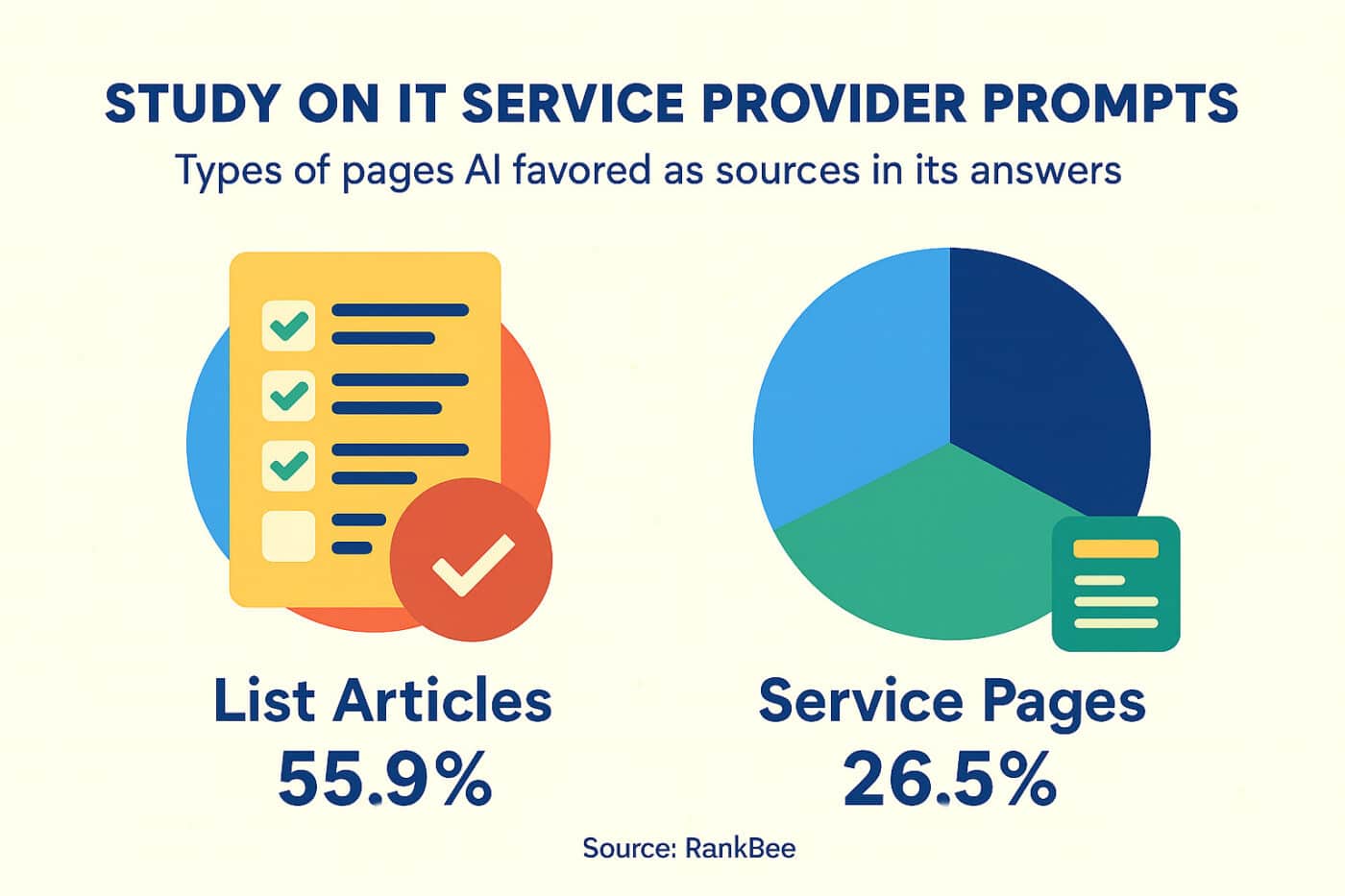
RankBee did a study (detailed in this SEOClarity webinar) on IT service provider prompts and analyzed what types of pages AI favored as sources in its answers. Based on the study, list articles (55.9%) and service pages (26.5%) dominate citations.
Use that insight to your advantage, and in addition to thorough, detailed service pages:
Write listicles like “10 Signs You Need X Service.”
Publish case studies that show your results.
Build a knowledge center or FAQ hub that answers common and niche questions.
Create local landing pages for every service area you serve.
D. Keep It Fresh & Relevant
You don’t need to post weekly just to post—but you do need to keep your content current:
Update older posts and service pages with new info or recent examples.
Add FAQs based on actual customer questions.
Use tools like Qforia (you need a Gemini API key to use QFOria) to find AI-related subqueries for your services, then answer them directly in your content.
Fill content gaps with your own expertise—not generic, AI-generated filler.
E. Remember: Your Website Is the AI’s Textbook
Everything AI knows about your business comes from what’s already out there—your website being the most direct source. If it’s not on your site, AI can’t recommend it. Rich, detailed, and trustworthy content is how you "train AI" to understand (and recommend) your business.
Every page is a chance to “train” AI on what you do.
If it’s not on your site, AI can’t learn it.
Make your services clear, detailed, and backed by proof.
Don’t be afraid to use AI as part of your content creation workflow—most marketers already do. A GoodFirms study found that 78% cite “faster content creation” as the top benefit of using LLMs for blogs, emails, and marketing copy. Note that while speed is great, accuracy, nuance, and expertise still matter. Use AI to draft, outline, or speed up the grunt work—but always keep a human in the loop to add real examples, avoid embarrassing missteps, and make sure the content truly reflects your voice and experience.
9. Make Your Content Easy for AI to Read, Understand, and Attribute
(Time to Impact: Medium | Difficulty: Medium)
Just like people, AI systems need clear, well-organized information to process it effectively. The easier it is for large language models (LLMs) to interpret your site, the more likely your business will be accurately represented—and cited—in AI-driven results.
How to Make Your Content AI-Friendly:
Use structured data schema (LocalBusiness, FAQ, HowTo, etc.) to give AI clear context about your business and content.
Add entity-based schema to connect your business to related concepts, people, and locations.
Keep your site fast and easy to navigate so AI (and humans) can quickly access all key pages.
Avoid unnecessarily blocking AI crawlers (like GPTBot) unless there’s a specific reason.
Why it matters: Structured, accessible content helps AI quickly scan, interpret, and attribute your business information—improving your chances of showing up in AI Overviews and other AI-powered search results.
10. Use Structured Data to Help Google Understand Your Site
(Time to Impact: Medium | Difficulty: Advanced)
Structured data—also called schema markup—is code you add to your website to give search engines extra context about your content. Think of it as labeling the “parts” of your site so Google and AI systems know exactly what they’re looking at.
For example, you can mark up:
LocalBusiness schema to define your business name, address, phone number, and service area.
FAQ schema to highlight common questions and answers on your site.
Review markup to showcase customer ratings.
HowTo schema to describe step-by-step processes.
Article schema to provide details about a blog post or news update.
Use entity-based schema to link your business to related people, places, and concepts—strengthening the connections Google makes about your expertise.
These signals not only help your site qualify for rich results in Google Search (like FAQs and star ratings), but they also make your content easier for AI to interpret, connect to related entities, and potentially cite.
A note for small business owners: Implementing schema markup can be a bit technical, so you may need to work with your webmaster or developer to get it right. My goal here is to introduce you to the idea—not to walk through the full how-to within this article.
Schema.org – Browse the full library of schema types and properties and also use their validator to check proper implementation.
11. Monitor, Test, and Iterate
Getting into AI Overviews or AI Mode isn’t a one-and-done effort—you need to keep checking whether your content is showing up and adjust over time.
Right now, there aren’t many tools (especially low-cost ones) that can fully track AI citations for you. The most practical approach for small businesses is a manual check on a short list of priority queries:
How to Monitor & Test AI Mentions:
Make a list of 10–20 high-value searches you’d love to appear for in AI results.
Once a month, search for each one in Google’s AI Mode and in a couple of LLMs like ChatGPT (with browsing) or Perplexity.
Note whether your site appears, which competitors are listed, and which external sources are cited.
Look for patterns—are certain competitors showing up everywhere? Are certain types of content always being referenced? Use those insights to refine your own content.
Why it matters: Even without fancy tools, consistent, focused monitoring gives you the data you need to adapt and increase your chances of landing in more AI-driven responses.
Wrap-Up: You Can’t Game This—But You Can Train for It
In the AI era, the businesses that win aren’t the ones looking for shortcuts—they’re the ones consistently providing the most trustworthy, useful, and clearly presented answers.
Think long-term:
Foundational, in-depth content is still your best SEO investment.
Authority is built over time through expertise, proof, and clarity.
The goal isn’t just to “rank,” but to become the source AI trusts enough to recommend.
AI Overviews and AI Mode reward depth, accuracy, and transparency. When your website becomes the resource that teaches AI about your services, you’re more likely to appear—often above traditional search results.
Liz Eisworth is the founder and lead designer of SangFroid Web located in Alpharetta, GA. As an experienced website designer and SEO strategist, Liz designs custom WordPress websites, optimizes websites for SEO, and leverages Local SEO / Google Business Profiles for business owners who are looking to improve their online presence to earn more traffic and leads. She built her first website for a business in 2003 and her first WordPress website in 2006. Learn more about Liz »